Key Takeaways
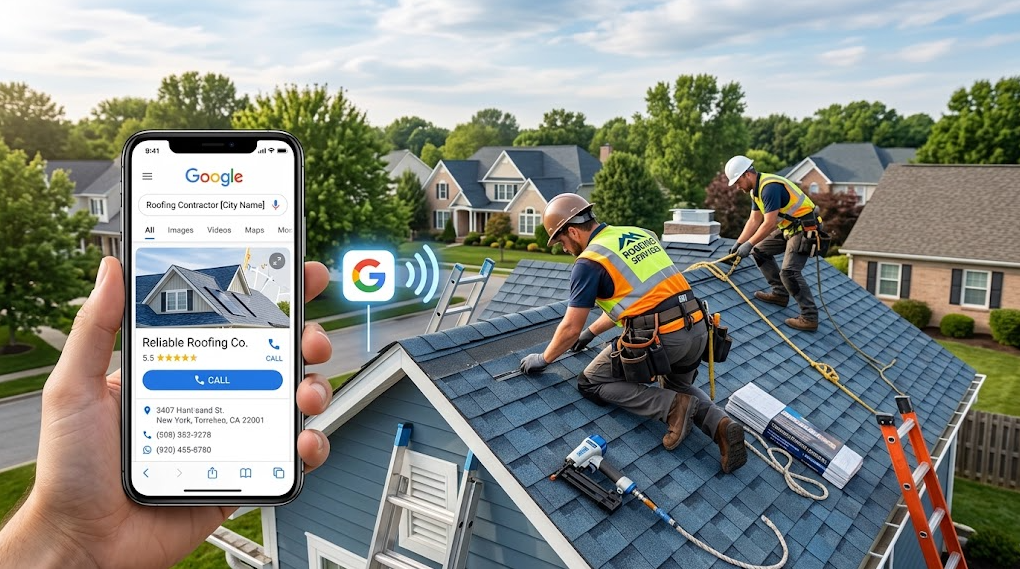
- Google reaches homeowners at the exact moment they need a roofer, when they type “roof leak repair,” “roof replacement contractor,” or “roofer near me,” which makes it one of the highest-intent lead sources a roofing company can build.
- Roofing companies can appear on Google in several places at once: the map pack, organic results, Local Services Ads, and Search ads. The strongest lead engines combine them.
- Your Google Business Profile is free to create and manage, and Google says local rankings depend mainly on relevance, distance, and prominence, which reviews and links help build. No one can pay for a better map ranking.
- Storms create the biggest roofing lead spikes of the year, and NOAA notes that hail alone can cause billions of dollars in damage. Ethical, fast, accurate storm marketing wins those leads without the tactics the FTC warns homeowners about.
- Track leads all the way to signed jobs and revenue. A roofer who knows that 100 leads became 12 jobs worth a known amount can budget and optimize; one who only counts calls cannot.
A homeowner who notices a water stain spreading across the ceiling does not wait for a roofing ad to appear in their social feed. They pick up their phone and search “roof leak repair near me.” Someone with a 25-year-old roof and a home inspection coming up searches “roof replacement cost” and then “roofing contractor” in their town. After a hailstorm, an entire neighborhood searches “storm damage roofing” within hours. That is what makes Google so valuable for roofing companies: it connects you with people who already have a problem and are actively looking for someone to fix it.
This guide covers every way a roofing company can turn Google into a steady source of leads and booked jobs: optimizing your Google Business Profile, ranking in Google Maps, building a website that ranks organically, using local SEO, creating content that brings in homeowners at every stage, running Local Services Ads and Search ads well, building a review engine, converting visitors into calls and estimate requests, handling storm season responsibly, and tracking every lead through to revenue. The goal throughout is not more traffic for its own sake. It is more qualified roofing leads, more inspections, and more signed jobs.
How Google Generates Leads for Roofing Companies
Before choosing tactics, it helps to understand how a roofing job typically starts on Google and where your business can show up along the way.
The roofing customer search funnel
Most roofing jobs follow a recognizable path: a problem appears, the homeowner searches, researches options, compares companies, makes contact, schedules an inspection, receives a quote, and signs for the job. Each type of problem produces a different first search. A roof leak leads to “roof leak repair near me.” An aging roof leads to “roof replacement cost.” Storm damage leads to “storm damage roofing contractor.” A home purchase leads to “roof inspection company.” Your visibility needs to cover those first searches and the comparison searches that follow, such as “best roofer in [city]” or a company’s name plus “reviews.”
The main ways roofing companies can get leads from Google
Google offers several distinct lead channels. They differ in cost, speed, and the kind of searcher they reach, and the most effective roofing companies use several together.
| Channel | Where it appears | How you pay | Best for |
| Google Business Profile | Google Maps and the local pack | Free to create and manage | Local calls, directions, and website visits |
| Organic SEO | Standard search results below ads and maps | Ongoing investment in pages, content, and links | Long-term, compounding lead flow |
| Local Services Ads | Top of many local results, with the Google Verified badge | Per valid lead | Phone and message leads for core services |
| Google Search Ads | Top and bottom of search results | Per click | Fast, targeted leads for chosen keywords |
| Reviews | Business Profile, Maps, and LSA listings | Time and process | Trust, conversion, and local prominence |
| Content | Organic results for questions and comparisons | Writing and expertise | Earlier-stage homeowners who become leads |
1. Optimize Your Google Business Profile for Roofing Leads
For a local roofing company, the Google Business Profile is the foundation of everything else. It powers your appearance in the map pack and Google Maps, it is often the first thing a homeowner sees when they search your company name, and it can generate calls directly from search results. Google states that a Business Profile lets you manage how your business appears on Maps and Search at no charge, so the only investment is the time and care it takes to do it well.
Claim and verify your Google Business Profile
Start by claiming and verifying the profile so you control what it says. Then make sure every core detail is right: your real business name exactly as it appears on your trucks, signage, and invoices; your correct address, or your service area if you work from home and do not receive customers there; a local phone number that is answered; your website; accurate business hours, including emergency availability if you offer it; and your primary business category. Google’s guidelines do not allow adding keywords or city names to the business name, and doing so is a common reason profiles get suspended.
Choose the right primary category
Your primary category is one of the strongest relevance signals on the profile. For most residential roofers, “Roofing contractor” is the natural primary choice. Secondary categories can capture separate lines of work, such as gutter services or siding if you offer them, but adding loosely related categories to appear in more searches tends to dilute relevance. Google’s guidelines recommend using as few categories as needed to describe the core business. Check periodically for newer, more specific category options.
Define your roofing service areas
If you travel to customers, list the cities, counties, or neighborhoods you serve. Be realistic. Listing every town within 100 miles does not make you rank in all of them, since distance remains part of how Google ranks local results, and it can attract calls from places you do not want to drive to. Focus the list on the areas where you want work and can respond quickly.
Build a complete roofing services list
The services section helps Google match your profile to specific searches and helps homeowners confirm you do what they need. List every service you offer, such as roof replacement, roof repair, emergency roof repair, roof inspection, storm damage repair, metal roofing, shingle roofing, flat roofing, commercial roofing, roof maintenance, and skylight repair. Add a short, clear description for each.
Optimize your GBP business description
Use the business description to explain, in plain language, what you do, where you do it, and why a homeowner should call you. Mention your main services, the areas you serve with natural geographic references, what sets you apart, such as years in business, warranties, certifications, or a family-owned crew, and close with a clear invitation to call or request an inspection. Skip keyword lists and promotional superlatives.
Add high-quality roofing photos
Photos turn a listing into proof. Upload real images of completed roofs, before-and-after projects, your crews at work, your trucks and equipment, work in progress, the roofing materials you install, and commercial jobs if you do them. Fresh, real photos help homeowners trust you and show that the business is active.
Publish Google Business Profile posts
Posts let you share timely updates right on your profile: a recent roof replacement, a storm damage project, seasonal roofing tips, a new service, a limited-time offer, or a short project case study. Posts are not a major ranking factor on their own, but they keep the profile current and give searchers another reason to choose you.
Use GBP to generate calls and website visits
Make every action button work for you. The call button should ring a phone that someone answers, ideally a tracked number set up so it does not disrupt your listing’s consistency. The website link should go to a relevant page, often your homepage or main service page. Directions help homeowners find a showroom or office if you have one. Where messaging or quote request features are available, turn them on only if someone will respond quickly, since an unanswered message does more harm than no button at all.
2. Get Roofing Leads From Google Maps
For many roofing searches, the first thing a homeowner sees is a map with three highlighted businesses. Earning a spot there is one of the most valuable outcomes in roofing marketing.
What is the Google local pack?
The local pack is the block of three map listings Google shows for searches with local intent, such as “roofer near me” or “roof repair [city].” It appears near the top of the results, often above the organic listings, and shows each business’s rating, review count, hours, and buttons to call, visit the website, or get directions. Clicking “more businesses” opens the full Google Maps view, where additional roofers appear.
What determines local pack visibility?
Google says local results are mainly based on relevance, distance, and prominence. Relevance is how well your profile matches the search, which depends on your categories, services, description, and website. Distance is how far you are from the searcher or the location in the search. Prominence is how well known your business is, and Google says it draws on information from across the web, including links to your site and your reviews. In practice, the roofers who win the local pack tend to combine a complete profile, strong and recent reviews, consistent business listings across directories, a relevant website, local links, and a reputation that extends beyond Google. Google also states that there is no way to request or pay for a better local ranking.
Create location-relevant roofing pages
Your website supports your map rankings, especially pages that tie your services to the places you serve. Examples include pages such as “Roofing Contractor in [City],” “Roof Repair in [City],” “Roof Replacement in [City],” “Emergency Roofing in [City],” and “Storm Damage Roofing in [City].” Each needs real local substance, covered in detail in the next section.
Build local authority
Local authority comes from being part of the community, online and off. Earn links and mentions by joining the local chamber of commerce and trade associations, sponsoring youth sports or community events, partnering with local real estate agents, home inspectors, and insurance agents, contributing expert comments to local news coverage after storms, supporting local charities, and listing your business accurately in reputable local directories. Each relationship can produce a link or a mention that reinforces your prominence in your market.
3. Rank Your Roofing Website in Google’s Organic Results
Organic results, the standard listings below the ads and the map pack, bring in a large share of roofing leads and keep doing so without a per-click cost. Roofing SEO takes longer to build than paid channels, but a website that ranks for the right searches becomes one of the most cost-effective lead sources a roofing company can own.
Perform roofing keyword research
Start by mapping the searches homeowners use at each stage of a roofing project. Group them into categories, because each group calls for a different type of page.
- Commercial keywords: roofing contractor, roofing company, roof replacement company, roofer near me.
- Service keywords: roof repair, roof replacement, roof inspection, emergency roof repair.
- Material keywords: asphalt shingle roofing, metal roofing, tile roofing, flat roofing.
- Problem-based keywords: leaking roof repair, missing shingles, roof storm damage, roof hail damage.
- Cost keywords: roof replacement cost, roof repair cost, metal roof cost.
- Location keywords: roofer in [city], roof repair [city], roof replacement [city].
Commercial and service keywords usually produce the most direct leads. Problem and cost keywords attract homeowners earlier in the process, who become leads when the content earns their trust.
Build dedicated roofing service pages
Each major service deserves its own useful page, because a homeowner searching “metal roofing” wants different information than someone searching “emergency roof repair.” A single roofing page that tries to cover everything rarely ranks well for anything specific. A practical site structure for a residential roofer might include separate pages for roofing, roof repair, roof replacement, roof inspection, storm damage roofing, emergency roofing, and metal roofing, with URLs such as /roof-repair/ and /roof-replacement/. Each page should explain the service, who it is for, signs a homeowner needs it, your process, materials and warranties, typical timelines, photos of your own work, reviews from customers who used that service, and a clear way to request an inspection.
Build location pages
If you serve several cities, location pages help you rank for searches in each one, organized under a structure such as /locations/ with individual pages like /locations/dallas/ and /locations/fort-worth/. The risk is the thin, copy-and-paste city page: the same text with only the city name changed, repeated across dozens of towns. Google treats pages built mainly to funnel visitors as doorway pages, and they rarely perform well. A strong location page includes things only that market can offer: projects you completed there with photos, reviews from local customers, the roofing styles and materials common in that area, local weather risks such as hail or high winds, permit notes for that municipality, and the neighborhoods you serve. If you have nothing distinctive to say about a town, hold off on the page until you do.
Optimize roofing page titles and meta descriptions
Titles and meta descriptions are what homeowners see in search results, so write them to earn the click. A title such as “Roof Repair in Plano, TX | Same-Week Inspections | [Company Name]” names the service, the place, and a reason to choose you. A meta description such as “Leaking roof? Our licensed Plano roofers repair shingles, flashing, and storm damage. Free inspections and written estimates. Call today.” tells the searcher exactly what to expect. Keep each one unique to its page.
Optimize roofing content for search intent
Every page should match what the searcher wants at that moment. Someone searching “emergency roof repair” needs a phone number, availability, and reassurance, fast. A search for “roof replacement cost” comes from someone who wants ranges, cost factors, and help understanding a quote. Type in “metal vs shingle roof,” and you expect a fair comparison. Look at what currently ranks for each search, then build a page that answers the question more completely and more clearly, using your own photos, prices, and experience.
Improve internal linking
Internal links help search engines understand your site and help homeowners find their next step. Link service pages to the location pages where you offer them, link blog posts to the related service page, link cost guides to your estimate request page, connect FAQs to the services they explain, and link case studies to both the service and the location involved. Use descriptive anchor text such as “roof replacement in Arlington” in place of “click here.”
4. Create Roofing Content That Generates Leads
Generic roofing tips, the kind that could appear on any roofer’s blog in any city, rarely bring in leads. The content that works answers the specific questions homeowners ask before they call, in a way that shows your expertise and nudges them toward an inspection.
Create content around high-intent searches
Focus first on questions asked by homeowners who are close to hiring. Good topics include how much roof replacement costs, how long a roof lasts, whether to repair or replace a roof, how much a new roof costs in your area, how to find a reliable roofing contractor, whether homeowners insurance covers roof replacement, and how long roof replacement takes. Each article should end with a clear next step, such as scheduling an inspection.
Target problem-based searches
Many roofing jobs begin with a symptom. Write content that matches the way homeowners describe what they see: why a roof is leaking, water coming through the ceiling after rain, a roof leaking around the chimney, missing shingles after a storm, or leaking roof flashing. Explain likely causes in plain language, what the homeowner can safely check, what not to do, and when to call a professional.
Create comparison content
Comparisons help homeowners make decisions and position you as a trusted advisor. Strong topics include roof repair versus replacement, metal versus asphalt shingles, roof replacement versus an overlay, and DIY roof repair versus hiring a roofer. Be honest about trade-offs; homeowners trust a roofer who tells them when a repair will do.
Create cost content
Cost guides attract homeowners who are actively budgeting for a project. Cover typical price ranges and the factors that move them: materials, labor, roof size, pitch, accessibility, tear-off of old layers, permits, and repairs to decking or flashing. Cost figures should reflect your local market and be updated regularly, since material and labor prices change. Showing real ranges for your area builds more trust than national averages that do not match the quotes homeowners receive.
Create seasonal roofing content
Seasonal content meets homeowners when roofing is on their mind. Topics include roof maintenance before winter, preparing a roof for hurricane season, what to do after hail damage, a spring roof inspection checklist, and common winter roof problems such as ice dams. Publish seasonal pieces a few weeks before the season begins so they have time to rank.
5. Use Google Local Services Ads to Generate Roofing Leads
Local Services Ads, often shortened to LSAs, sit at the very top of many local search results and work differently from standard Google ads. Instead of paying for clicks, roofers pay for leads.
What are Google Local Services Ads?
Google describes Local Services Ads as a way to advertise on Google and receive leads directly from potential customers as phone calls and messages sent through the ad. Businesses “pay only for leads related to your business and the services you offer,” according to Google. Eligible businesses that pass Google’s screening can display a Google Verified badge, which Google says signals that the business has passed its proprietary screening process.
How Local Services Ads work for roofers
The typical flow is simple. A homeowner searches for a roofing service, your Local Services Ad appears, the homeowner calls, messages, or requests a booking, the lead arrives in your account and inbox, and you follow up. Google’s help center says leads can come from answered calls or voicemails, messages, booking requests in the US and Canada, and missed calls that you return.
Roofing eligibility and verification
To run Local Services Ads, a business must complete Google’s verification, which includes submitting business licenses or registration where required, meeting insurance requirements, and having reviews, along with setting up billing. Requirements vary by location and service category, so check the current rules for roofing in your area before you start.
Optimize your LSA profile
Your LSA profile competes on many of the same signals as your Business Profile. Keep business information accurate, select every service you offer, set service areas where you want jobs, gather steady reviews, add photos, set hours that match when someone can answer, and respond to leads quickly. Responsiveness matters, since an unanswered lead is money spent with nothing to show for it.
Manage your LSA budget
You set a weekly budget, and Google charges for valid leads up to that budget. Watch lead volume and lead quality together, and track cost per lead, cost per booked inspection, and cost per customer. Google’s help center says leads judged invalid or low quality are not charged, and charged leads may receive automatic credits within about 30 days if later found to be low quality, though Google no longer credits leads for job types or areas you do not service, so keep your service and area settings accurate.
Track which LSA leads become jobs
Do not judge LSAs on lead count alone. Mark each lead’s outcome, whether it became an inspection, an estimate, or a signed job, and compare the cost per signed job with your other channels. A channel that produces fewer leads but more roof replacements is worth more than one that produces many small repair calls.
6. Run Google Search Ads for Roofing Leads
Google Search ads put your company at the top of results for the keywords you choose, and you pay when someone clicks. They are the fastest way to buy visibility for specific searches, and they require careful management to stay profitable.
When Google Ads makes sense for roofers
Search ads are most useful when you need leads quickly, while SEO is still building, when you want to target high-value services such as full replacements or commercial work, when you are entering a new market, or when storm activity creates a short window of intense demand. They make less sense if you cannot answer calls quickly or do not have landing pages built to convert.
Target high-intent roofing keywords
Focus spending on searches from people ready to hire, such as roofing contractor near me, roof replacement company, emergency roof repair, roof repair company, and storm damage roofer. Broad informational searches can wait for your content and SEO.
Use negative keywords
Negative keywords stop your ads from showing for searches you do not want to pay for. Common roofing negatives include jobs, salary, training, course, DIY, free, images, and materials, since people searching for roofing jobs or DIY instructions are not your customers. Review your search terms report regularly and keep adding to the list.
Create dedicated landing pages
Sending every ad click to your homepage forces visitors to hunt for what they searched for, and many leave. A dedicated landing page that matches the ad, such as a roof repair page for roof repair ads, with a clear offer, phone number, and short form, usually converts far better.
Write roofing ad copy that converts
Strong roofing ads name the service and location, include a trust signal such as years in business, warranties, licensing, or review rating, give a clear call to action such as scheduling a free inspection, and mention emergency availability where you offer it around the clock. Make sure every claim in the ad matches what the landing page and your crews deliver.
Use call extensions and lead features where available
Call assets let mobile searchers ring you straight from the ad, which suits urgent roofing problems. Lead form features, where available, let homeowners request an estimate without leaving Google. Both work only if someone responds quickly.
Track cost per qualified lead
Measure Google Ads by what matters: cost per qualified lead and cost per signed job, not clicks or impressions. Set up conversion tracking for calls and form submissions, then follow those leads through your sales process to see which keywords produce real work.
7. Build a Roofing Review Strategy
Reviews influence nearly every roofing lead from Google. They affect where your Business Profile appears in Maps, how your Local Services Ad performs, and whether a homeowner trusts you enough to call. A roof is an expensive purchase that most homeowners make only a few times in their lives, so they read reviews closely before letting a crew on their house.
Why reviews matter for roofing companies
Google lists prominence as one of the three main factors in local ranking and says review count and score are part of how it judges prominence. Beyond rankings, reviews do the selling: they tell a nervous homeowner that you show up on time, clean up the yard, handle insurance paperwork well, and stand behind your work.
Ask for reviews at the right time
Timing makes a large difference in response rates. Good moments to ask include right after a successful roof replacement, after the final walkthrough, when the customer expresses satisfaction, and after a repair that solved a stubborn leak. Ask in person first, then follow with a text or email that includes a direct link to your review page.
Make reviewing easy
Every extra step costs you reviews. Use a short review link or QR code, send the request by text, keep the message brief and personal, and train crew leads and project managers to ask at the end of each job. A printed card with a QR code left at the house after the final cleanup works well for homeowners who prefer not to deal with links.
Encourage detailed reviews
A review that says “Great job!” helps a little. A review that mentions the service, the town, the material, and the experience helps far more, because it gives other homeowners specific reasons to trust you. Without writing the review for them, you can invite customers to mention what work was done, how the crew behaved, how cleanup went, and whether the project stayed on schedule.
Respond to every review
Respond to positive and negative reviews alike. Thank happy customers by name and mention the project. For negative reviews, stay calm and professional, acknowledge the concern, avoid arguing in public, and offer to resolve the issue offline. Future customers read your responses as closely as the reviews themselves.
Follow the rules on reviews
The Federal Trade Commission’s rule on consumer reviews and testimonials, in effect since October 2024, prohibits fake reviews, buying positive reviews, offering incentives conditioned on a positive review, and suppressing negative reviews through threats or intimidation. The FTC’s guidance on soliciting reviews also warns against asking only customers you expect to be happy. Ask every customer, accept the mix of feedback that comes back, and fix the problems that negative reviews reveal.
8. Turn Google Traffic Into Roofing Leads
Ranking in Google only matters if visitors turn into calls, form fills, and booked inspections. Many roofing websites attract decent traffic and still lose most of it, because the site makes it hard to trust the company or take the next step.
Make your phone number visible
Place your phone number in the header of every page, make it click-to-call on mobile, and add a sticky call button so it stays on screen as visitors scroll. Homeowners with water coming through the ceiling will not search your site for a way to reach you.
Use clear calls to action
Tell visitors exactly what to do next. Calls to action such as “Schedule a Free Roof Inspection,” “Request a Roof Replacement Estimate,” “Call for Emergency Roof Repair,” or “Get Storm Damage Inspected” work because they match the visitor’s situation. A vague button that says “Learn More” or “Submit” gives them no reason to act.
Simplify your lead forms
Ask only for what you need to follow up: name, phone number, address, the service needed, and a short description of the problem. Optional photo uploads help with roof leaks and storm damage, since your estimator can see the issue before calling back. Every extra required field costs you some leads.
Add trust signals
Homeowners worry about storm chasers, poor workmanship, and contractors who disappear after taking a deposit. Ease those worries with your license number where your state licenses roofers, proof of insurance, manufacturer certifications you hold, warranty details, review ratings, before-and-after photos, years in business, and community involvement. Show these near your calls to action, where the hesitation happens.
Show real roofing projects
Stock photos make every roofer look the same. Your own project photos, especially before-and-after shots, prove what your crews can do. Add a short description for each project covering the location, problem, material used, and outcome, and connect it to the relevant service and location pages.
Use multiple lead options
Different homeowners prefer different ways to make contact. Offer phone calls, text messaging, contact forms, online booking, and chat if you can staff it well. Each extra option catches leads who would not have used the others, as long as someone responds to every one of them quickly.
9. Build Dedicated Roofing Landing Pages
A landing page is built for one purpose: turning a specific visitor into a lead. Paid traffic needs landing pages most, but strong service and storm pages follow the same principles. The page should focus on one service and one offer, match the search or ad that brought the visitor, and remove anything that distracts from contacting you.
What a high-converting roofing landing page includes
- A clear service-focused headline that matches the search, such as “Emergency Roof Repair in Tulsa.”
- Your service area, stated near the top.
- A main call to action, repeated through the page.
- A click-to-call phone number.
- Customer reviews, ideally from that service and area.
- Project photos of your own work.
- Warranty information.
- Licensing and insurance details.
- Manufacturer certifications, if you hold them.
- Answers to the common questions about that service.
- A short lead form.
- Fast loading on mobile devices.
Create separate landing pages by service
Separate pages let the message match the visitor. Good candidates include roof repair, roof replacement, storm damage, metal roofing, commercial roofing, and emergency roof repair. Someone clicking an ad for metal roofing should land on a page about metal roofing, not a general page that mentions it in one line.
10. Target Roofing Leads After Storms and Severe Weather
Storms create sudden spikes in roofing demand. The National Severe Storms Laboratory notes that “hail can cause billions of dollars of damage to structures, crops and livestock,” and after a major hail or wind event, searches for roof inspections and storm damage repair climb sharply in the affected area. The roofing companies that prepared before the storm capture most of that demand.
Create storm damage pages
Build these pages before storm season, so they are already indexed when you need them. Useful pages include hail damage roof repair, wind damage roof repair, storm damage roof inspection, emergency tarping, and help with roof insurance claims. Explain the warning signs of damage, why inspections matter even when nothing is visible from the ground, how your inspection works, and what happens next.
Prepare your Google Business Profile for storm activity
When a storm hits, update your Business Profile quickly. Publish a post about storm inspections, confirm your hours and availability, add storm-related photos from real jobs, and make sure your phone line can handle the volume. If you add emergency hours, honor them.
Use Google Ads strategically after storms
Paid ads give you immediate visibility in the hardest-hit areas. Target zip codes with confirmed damage, adjust budgets to match lead volume and crew capacity, and send traffic to storm-specific landing pages. Avoid scaling spend beyond what your team can inspect within a reasonable time, because slow follow-up wastes the leads you paid for.
Avoid aggressive or misleading storm marketing
Homeowners after a storm are stressed and wary, with good reason. The Federal Trade Commission warns consumers that scammers often show up after severe weather, and it advises homeowners to avoid contractors who demand payment up front, push them to decide immediately, or ask to be paid by wire transfer, gift card, payment app, cryptocurrency, or cash. The FTC also tells consumers to check licenses with their state or county, ask for proof of insurance, get a detailed written contract, and collect three written bids. Market in a way that passes that test: no exaggerated damage claims, no fear tactics, no promises about what insurance will pay, clear written estimates, and verifiable credentials. Ethical storm marketing is also the strategy that keeps your reviews strong and your company in business after the storm season ends.
11. Build a Roofing Lead Funnel From Google
Treat Google lead generation as a full funnel, not just a traffic source. Leads leak out at every stage, and fixing a leak in the middle of the funnel can produce more jobs than doubling your traffic.
The roofing Google lead funnel
- A homeowner searches for a roofing service.
- Your company appears in Maps, organic results, Local Services Ads, or search ads.
- The homeowner visits your Business Profile or website.
- They review your services, reviews, photos, and trust signals.
- They call, submit a form, or request an inspection.
- Your team qualifies the lead.
- Your team schedules the inspection.
- Your estimator presents the proposal.
- The homeowner signs the contract.
- Your team completes the job.
- You ask for a review and referral.
Optimize every stage
Each stage has its own common leaks. Poor rankings mean homeowners never see you. A weak search result, with a vague title or a thin profile, means they see you and choose someone else. A poor or slow website loses them after the click, and an unclear call to action leaves them unsure what to do. Missed calls, slow replies to forms, untrained call handlers, weak follow-up after inspections, and confusing proposals lose the ones who did reach out. Many roofers discover that their real problem is missed calls, not a lack of leads, so audit the back half of the funnel before spending more on the front.
12. Track Your Roofing Leads From Google
You cannot improve what you cannot measure. Without tracking, you will not know which channel produced your best jobs, which keywords waste money, or whether your SEO investment is paying off.
Track calls
Call tracking assigns unique numbers to different sources so you know where each call came from. Use it carefully with your Business Profile. Google’s guidelines allow a tracking number as the primary phone as long as your main local number is listed as an additional number, which keeps your business information consistent across the web. Record which calls become inspections and jobs.
Track form submissions
Use conversion tracking in Google Analytics and Google Ads to record form fills, and capture the source of each submission in your CRM. Store the landing page, the campaign, and whether the lead came from organic, paid, or Maps.
Track live chat and message leads
Chat widgets, text messages, and Business Profile messages are easy to forget because they do not ring a phone. Log every conversation with its source, and make sure messages are answered as quickly as calls.
Track Google Business Profile activity
Your Business Profile performance report shows calls, website clicks, direction requests, and the searches that triggered your profile. Watch these alongside your rankings to see whether profile improvements translate into more contact.
Track organic traffic
Google Search Console shows which searches bring visitors to your site, which pages they land on, and how your click-through rate changes over time. Pair it with Google Analytics 4 to see what those visitors do next, especially whether they call or submit a form.
Track Google Ads and Local Services Ads
Import call and form conversions into Google Ads so the platform optimizes toward leads, not clicks. For Local Services Ads, review each lead inside the account, mark which ones you booked, and dispute or flag leads that fall outside your services or area. Both channels need their results tied back to jobs, because a cheap lead that never closes is expensive.
Track leads in a CRM
A CRM ties every lead to its outcome. For each lead, record the source, campaign, service requested, location, appointment status, estimate amount, close status, and revenue. Over time this record tells you exactly which channels and services make you money.
Connect leads to actual revenue
Do not stop at “we generated 100 leads.” The full picture comes from following leads all the way to revenue. The example below shows how 100 leads from Google can narrow to 12 signed jobs, and why every stage deserves attention.
| Stage | Count | Conversion from previous stage |
| Leads from Google | 100 | – |
| Qualified leads | 60 | 60% |
| Inspections completed | 40 | 67% |
| Estimates presented | 25 | 63% |
| Signed jobs | 12 | 48% |
| Revenue | 12 x average job value | Tracked per channel in your CRM |
In this example, raising the qualified-to-inspection rate from 67% to 80% would add roughly two more signed jobs for every 100 leads without a single extra lead. Your own numbers will differ, which is the point of tracking them.
13. Roofing SEO Metrics That Actually Matter
Many roofing companies track the wrong things. Vanity metrics such as impressions and raw traffic feel good in a monthly report, but they do not pay for trucks or crews. Business metrics connect marketing activity to inspections, contracts, and revenue. Track both, and judge success by the second group.
Rankings
Rankings show whether your pages and profile are visible for the searches that matter. Track positions for your core services in each target city, in both organic results and the map pack, and remember that local rankings shift depending on where the searcher stands.
Organic traffic
Organic traffic tells you whether rankings translate into visits. Watch traffic to service and location pages more closely than total site traffic, since a viral blog post read by people in other states will never become a roofing job.
Local pack visibility
Map pack visibility often drives more roofing calls than organic listings. Grid-based rank tracking shows how your visibility changes across your service area, which helps you spot neighborhoods where competitors outrank you.
Phone calls and form leads
Calls and forms are the first true business metric. Count them by source, and separate real leads from spam, job seekers, vendor pitches, and out-of-area requests.
Qualified leads
A qualified lead is a homeowner or property manager in your service area who needs a service you provide. This is the number that should grow month over month.
Cost per lead and cost per acquisition
Cost per lead tells you what each inquiry costs. Cost per acquisition, the total marketing cost divided by signed jobs, tells you what each customer costs, and it is the number that decides whether a channel is profitable.
Lead-to-customer rate
This rate shows how well your team turns leads into signed contracts. If it falls while lead volume rises, the problem may be lead quality, response speed, or the sales process, not marketing.
Revenue from organic search and ROI
The final measure is revenue traced to each channel, compared with what you spent on it. Return on investment is revenue minus cost, divided by cost. SEO’s return improves over time because rankings keep producing leads after the work that earned them is done.
14. Common Mistakes Roofing Companies Make With Google
Most roofing companies that struggle with Google leads make some of the same mistakes. Each one is fixable, and fixing even two or three can change results within a few months.
Only optimizing the homepage
The homepage cannot rank for roof repair, replacement, inspections, metal roofing, and storm damage all at once. Each major service needs its own optimized page.
Targeting only “roofing contractor”
Everyone fights over the broadest term. Service, material, problem, and cost keywords together bring in more leads, often at lower competition.
Creating thin city pages
Pages that swap only the city name read as low-value doorway pages and rarely rank. Build location pages with real local projects, reviews, and details, or skip them.
Publishing generic AI-generated roofing content
Content that repeats what every other roofing site says, with no local detail, real photos, or field experience, gives Google and homeowners no reason to choose it. Google’s guidance focuses on whether content is helpful and original, not on how it was produced, and mass-produced filler fails that test. Use tools to assist if you like, but publish pages that reflect your own crews, prices, and projects.
Ignoring Google Maps
An incomplete, outdated, or unverified Business Profile wastes the most valuable local lead source you have. Fill in every relevant field, choose the right primary category, and keep the profile active.
Ignoring reviews
Roofers who wait for happy customers to leave reviews on their own fall behind competitors who ask after every job. Build review requests into your project closeout process.
Buying links or reviews
Purchased reviews break the FTC’s review rule and Google’s policies, and bought links violate Google’s spam policies. Both can trigger penalties that take far longer to fix than the shortcut saved.
Sending paid traffic to the homepage
Paid clicks sent to a general homepage convert worse than clicks sent to a focused landing page. Match each campaign to a dedicated page.
Focusing on traffic instead of leads
A traffic increase means little if calls and jobs stay flat. Judge every channel by the inspections, contracts, and revenue it produces.
Not tracking phone calls
For most roofers, the majority of leads arrive by phone. Without call tracking, you cannot tell which channel or keyword produced them.
Responding slowly to leads
Homeowners with a leaking roof contact several companies and hire the first one that responds well. Every hour of delay hands leads to competitors, and missed after-hours calls are especially costly during storm season.
Having a poor mobile website
Most homeowners searching for a roofer in an emergency are on a phone. Slow pages, tiny buttons, and forms that are painful to fill out on mobile drive them straight back to the search results.
Not updating old roofing content
Cost guides with prices from years ago, outdated photos, and expired offers make your company look neglected. Review key pages at least once a year and refresh prices, projects, and reviews.
Trying to rank for every roofing keyword with one page
A single page targeting dozens of services and cities ends up relevant to none of them. Give each important topic its own focused page and link them together.
15. How Much Does It Cost to Get Roofing Leads From Google?
Roofing lead costs vary widely by market, season, service type, competition, and channel. Hail-prone metros and large cities usually cost more than small towns, and replacement leads cost more than repair leads. National averages are a poor guide; your own data is the best one. The economics look different for each channel.
Google Business Profile
A Google Business Profile is free to create and manage, according to Google. The real costs are the time or fees for profile optimization, the SEO work that supports it, photo and post content, and review management.
Organic SEO
SEO costs depend on who does the work and how much of it is needed. An agency brings a team covering content, technical SEO, and link acquisition. A freelancer can cost less but usually covers fewer areas. An in-house hire gives you control but adds salary, tools, and training. Whatever the model, budget for content, local link acquisition, and technical fixes. Unlike paid ads, the value of SEO work compounds, because pages that rank keep producing leads without a per-click charge.
Google Search Ads
The true cost of search ads is ad spend plus management cost plus the cost of building and testing landing pages. Roofing keywords rank among the more expensive home service terms because a single job is worth so much, so poor management gets expensive quickly.
Local Services Ads
The LSA cost model is simple: lead cost multiplied by the number of leads. Lead prices depend on your market, service type, and competition, and you control total spend with a weekly budget.
Calculate your maximum affordable cost per lead
The cost per lead you can afford depends on your own numbers, not on industry averages. Start with this formula, which gives you the maximum you can spend to win one customer: Average customer value × Gross profit margin × Acceptable acquisition percentage.
For example, if your average roof replacement is $15,000, your gross margin is 35%, and you are willing to spend 20% of gross profit to acquire a customer, you can afford about $1,050 per signed job. If one in five leads becomes a signed job, your maximum cost per lead is roughly $210. The acceptable percentage varies by business: a company with strong referral flow and full crews may accept less, while a company trying to grow into a new market may accept more for a while. Run this math for each service, because repair jobs and replacement jobs support very different lead costs.
16. SEO vs Google Ads vs Local Services Ads for Roofing Companies
No single channel is best for every roofing company. Each plays a different role, and the strongest roofers combine them.
| Factor | SEO | Google Ads | Local Services Ads |
| Speed | Slower, builds over months | Fast | Fast once verified |
| Long-term value | Builds over time | Requires ongoing spend | Requires ongoing spend |
| Cost model | Ongoing investment | Per click | Per lead |
| Local visibility | Strong in organic and Maps | Strong for chosen keywords | Strong at top of local results |
| Scalability | High | High | Variable, depends on market and budget |
| Requires website | Yes | Usually, for landing pages | Not in the same way, leads come through Google |
| Best suited for | Long-term demand capture | Immediate and seasonal demand | Steady local service leads |
When to use each channel
SEO suits roofers who plan to be in their market for years and want lead costs to fall over time. Google Ads suits companies that need leads now, want to push high-value services, are entering a new market, or need to capture a storm window. Local Services Ads suit roofers who want pay-per-lead pricing and the trust of the Google Verified badge, and who can answer calls promptly. For most established roofers, the best mix is a strong Business Profile and SEO foundation, Local Services Ads for steady volume, and search ads for specific services and seasonal spikes.
17. How to Build a Roofing Google Lead Generation Strategy
A strategy puts these channels in the right order. Trying to do everything at once usually means doing nothing well, so work through these phases in sequence.
Phase 1, Foundation
Start with the basics every other channel depends on: an optimized Google Business Profile, a fast and mobile-friendly website, call and form tracking, Google Analytics 4, Google Search Console, and a working review process.
Phase 2, Commercial SEO
Build the pages that capture your most valuable searches: service pages for repair, replacement, inspection, storm damage, emergency work, and the materials you install, followed by useful location pages and high-intent content such as cost and comparison guides.
Phase 3, Local authority
Grow the signals that make Google trust your company in your area: steady reviews, accurate citations in directories and industry listings, local links from suppliers and associations, partnerships with real estate agents and property managers, and an active community presence through sponsorships and events.
Phase 4, Paid acquisition
Launch Local Services Ads and Google Search ads once tracking is in place, with dedicated campaign landing pages for each major service.
Phase 5, Conversion optimization
Improve calls to action, shorten forms, test phone placement, add trust signals, and review call recordings to see where conversations go wrong.
Phase 6, Measurement
Track leads, qualified leads, estimates, closed jobs, revenue, cost per lead, and cost per acquisition for every channel. Use the results to move budget toward what produces signed contracts.
18. 90-Day Roofing Google Lead Generation Plan
The plan below turns the strategy into a realistic first quarter. Adjust the pace to your team’s capacity, but keep the order.
Month-by-month plan
| Timeframe | Focus | Key actions |
| Month 1, weeks 1-2 | Audit and setup | Google Business Profile audit, website audit, technical SEO review, keyword research, conversion and call tracking |
| Month 1, weeks 3-4 | Quick wins | Optimize Business Profile, improve core service pages, strengthen calls to action, set up review requests |
| Month 2 | Expansion | Build location and service pages, publish commercial content, build local citations, begin link acquisition, improve internal linking |
| Month 3 | Lead generation | Launch or optimize Google Ads, consider Local Services Ads, build campaign landing pages, improve conversion rates, analyze lead quality, expand winning keywords |
What to expect by day 90
Expect paid channels to produce leads within the first weeks and SEO results to build gradually over the following months. By day 90 you should know your cost per lead by channel, your biggest funnel leaks, and which services to push next.
Roofing Google Lead Generation Checklist
Use this checklist to audit where your company stands today. Every unchecked box is a lead source you are not using fully.
Checklist by area
| Area | Items to check |
| Google Business Profile | ☐ Profile claimed and verified ☐ Correct primary category ☐ Relevant secondary categories ☐ Complete services list ☐ Correct service areas ☐ Updated photos ☐ Regular posts ☐ Review strategy |
| Website | ☐ Mobile-friendly ☐ Fast loading ☐ HTTPS ☐ Clear phone number ☐ Strong calls to action ☐ Quote form ☐ Service pages ☐ Location pages ☐ Trust signals |
| SEO | ☐ Keyword research ☐ On-page optimization ☐ Internal linking ☐ Local SEO ☐ Technical SEO ☐ Content strategy ☐ Local links |
| Paid | ☐ Google Ads ☐ Local Services Ads ☐ Negative keywords ☐ Landing pages ☐ Conversion tracking |
| Measurement | ☐ Google Analytics 4 ☐ Google Search Console ☐ Call tracking ☐ Form tracking ☐ CRM ☐ Revenue attribution |
Why Roofing Companies Choose Click Metrica to Get More Leads From Google
Everything in this guide works, but it takes steady, coordinated effort across your Business Profile, website, content, reviews, and tracking. Most roofing owners are busy running crews, meeting adjusters, and closing estimates, and that work rarely leaves time for keyword research or rebuilding service pages. That is where Click Metrica comes in. Click Metrica, the publisher of this guide, is an SEO agency that helps local service businesses such as roofing companies rank higher in Google Search and Google Maps and turn that visibility into calls and booked inspections.
What Click Metrica does for roofers
Click Metrica’s work follows the same system laid out above: a full audit of your Google Business Profile and website, keyword research built around the services and towns you want to grow, service and location pages written to rank and convert, technical fixes for speed and mobile usability, local citation and link building, review process guidance, and lead tracking that connects rankings to revenue. The focus stays on the metrics that matter to a roofing business, which are calls, inspections, and signed jobs, not vanity traffic.
White hat SEO built for long-term results
Click Metrica uses white hat SEO only, meaning methods that stay within Google’s published guidelines. There are no bought links, fake reviews, keyword-stuffed business names, or ranking guarantees. That matters in roofing, where a profile suspension or penalty during storm season can cost a company months of leads. The goal is a lead engine that keeps growing year after year, so you depend less on paid clicks over time.
Transparent pricing and a simple start
Click Metrica publishes its pricing so roofers can plan before a sales call. Plans start at $1,000 a month for foundational local SEO, with $2,000 and $3,000 monthly plans that add more content and authority building for competitive markets. Every engagement starts with a preliminary site review and a 30-minute strategy call, and a tailored proposal usually follows within 48 hours. If you want to know where your roofing company is losing leads today, get a free SEO audit at https://clickmetrica.com/contact/.
Frequently Asked Questions About Getting Roofing Leads From Google
How do I get roofing leads from Google for free?
The main free sources are your Google Business Profile and organic search rankings. Google does not charge for a Business Profile, and organic and map listings cost nothing per click. You still need to invest time or money in optimizing your profile, building service pages, earning reviews, and creating useful content, but the leads themselves carry no per-lead fee.
How do roofing companies get leads from Google Maps?
Roofers get Maps leads by maintaining a complete, verified Business Profile with the correct primary category, accurate service areas, a full list of services, real project photos, and a steady stream of reviews. Google ranks local results by relevance, distance, and prominence, and strong service pages and local links on your website support all three.
How much does a roofing lead from Google cost?
It depends on your market, the service, the season, and the channel. Organic and Maps leads have no per-lead fee but require ongoing SEO investment. Local Services Ads charge per lead, and Google Ads charge per click, with costs driven by competition in your area. Calculate what you can afford using your average job value, gross margin, and close rate, then compare each channel against that number.
Is Google Ads worth it for roofing companies?
Google Ads can be very profitable for roofers who target high-intent keywords, use strong negative keyword lists, send clicks to dedicated landing pages, answer calls quickly, and track results to signed jobs. It loses money for roofers who bid on broad terms, send traffic to the homepage, or measure clicks instead of contracts.
How long does roofing SEO take to generate leads?
Business Profile improvements can increase calls within weeks. Organic rankings for competitive roofing terms usually take several months to build, and many companies see meaningful lead growth from SEO between six and twelve months, depending on competition, website condition, and how consistently the work is done.
How do I rank my roofing company on Google?
Build dedicated pages for each major service and primary service area, optimize titles and content for the searches homeowners use, fix technical problems that slow your site, earn reviews and local links, and keep your Business Profile complete and active. Consistency over months matters more than any single tactic.
How do I get my roofing company into the Google 3-pack?
The local 3-pack rewards relevance, distance, and prominence. Choose the right primary category, list your services, define accurate service areas, add photos, collect reviews steadily, respond to them, and support your profile with strong location-relevant pages and local links. Google states that you cannot pay for a better local ranking.
How many Google reviews does a roofing company need?
There is no fixed number. Look at the review counts of the roofers ranking in your local pack and aim to match or exceed them over time. A steady flow of recent, detailed reviews is more valuable than a large batch collected once and then forgotten.
What keywords should roofing companies target?
Focus first on high-intent keywords such as roof repair, roof replacement, roofing contractor near me, emergency roof repair, and storm damage roofing, combined with your city names. Then add material, problem, and cost keywords such as metal roofing, roof leak repair, and roof replacement cost to reach homeowners earlier in the process.
How can I get more roof replacement leads?
Build a detailed roof replacement page, publish cost and repair-versus-replace guides, show before-and-after replacement projects, collect reviews that mention replacements, and target replacement keywords in Google Ads and Local Services Ads. Offer financing information if you provide it, since cost is the biggest barrier for homeowners.
How can I generate emergency roofing leads?
Create an emergency roof repair page, list accurate hours on your Business Profile, run call-focused ads for emergency keywords, and make sure every call is answered day and night. Emergency leads go to whoever answers first.
How can I get storm damage roofing leads?
Prepare storm damage pages before storm season, update your Business Profile quickly after severe weather, target affected areas with ads, and publish helpful post-storm guidance. Keep your marketing honest, because homeowners are wary of storm chasers and the FTC actively warns them about contractors who pressure them or demand payment up front.
Should roofers use SEO or Google Ads?
Most roofers benefit from both. Google Ads delivers leads quickly and gives you control over spend, while SEO builds long-term visibility that lowers your cost per lead over time. Many companies use ads to fill the pipeline while SEO gains momentum, then rebalance as organic leads grow.
How do I track roofing leads from Google?
Use call tracking, form conversion tracking, Google Analytics 4, Google Search Console, your Business Profile performance report, and the reporting inside Google Ads and Local Services Ads. Then record every lead’s source and outcome in a CRM so you can connect each channel to inspections, signed jobs, and revenue.
How much should a roofing company spend on Google marketing?
Base your budget on your growth goals and your numbers. Work out the maximum you can spend per signed job using average job value and gross margin, estimate how many jobs you want from Google each month, and set your combined SEO and ads budget from there. Review the budget quarterly as you learn which channels produce the best jobs.
Final Takeaway, Building a Predictable Roofing Lead Engine From Google
Getting roofing leads from Google is not a single tactic. It is a chain: Google visibility leads to a qualified search, which leads to your website or Business Profile, then to a conversion, a lead, an inspection, an estimate, a customer, and finally revenue. Every link in that chain can be measured and improved.
Treat Google as an acquisition system
The roofing companies that win treat Google as an integrated acquisition system, not just an SEO channel. They combine local SEO, organic rankings, Google Maps, reviews, Google Ads, Local Services Ads, helpful content, conversion optimization, and lead tracking, and they keep improving each piece. The Bureau of Labor Statistics projects employment of roofers to grow about 5 percent over the next decade, so competition for homeowners in your market is unlikely to ease. The companies that build their Google lead engine now will own more of that demand later.
Get a free roofing lead generation audit
Need help generating more roofing leads from Google? Get a free roofing SEO and lead generation audit from Click Metrica at https://clickmetrica.com/contact/ and find out exactly where your company is losing leads and what to fix first.