
Key Takeaways
- Click Metrica takes the top spot on a 5.0 average across 100+ verified reviews, a services mix that is 100% SEO, and 15 out of 15 five-star reviews tied specifically to local search.
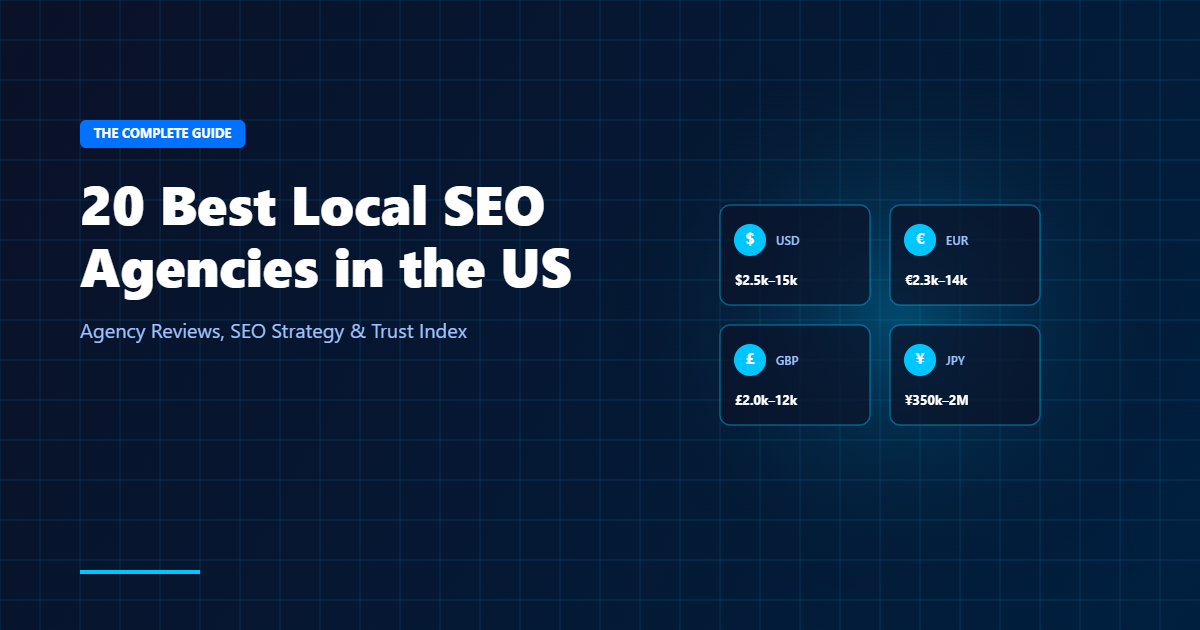
- Pricing across the US market falls into three recognizable bands. Standardized programs run $500 to $1,500 per month, specialist operators charge $2,500 to $10,000, and enterprise multi-location work starts above that.
- Google names relevance, distance, and prominence as the primary inputs to local results. Distance is fixed, so almost everything an agency can influence lives in profile relevance and earned prominence.
- Reviews move money. A one-star rating increase has been measured at a 5% to 9% revenue lift for independent businesses, and since October 2024 the FTC has attached civil penalties of up to $51,744 per violation to fake, paid, or suppressed reviews.
- Headcount predicts process, not performance. Several firms below with fewer than 50 employees beat 500-person shops on local outcomes, because local search is a specialty rather than a service-menu line item.
- Fit beats reputation. A single-location plumber, a 200-location franchise, and a personal injury firm need three different operating models, and each entry below names the buyer it was built for.
How We Ranked These Agencies
Most agency roundups are pay-to-play. Directories sell placement, listicles sell leads, and the ordering usually reveals more about the publisher’s affiliate arrangements than about who can move a map pack. At Click Metrica, we took a different approach in this market: we put our evaluation criteria on the table so you can see exactly how the rankings were determined and weight those criteria differently if your priorities differ.
The Criteria That Decided Placement
Five inputs decided placement. Verified review depth came first, weighted toward reviews that name local search rather than generic digital marketing. Declared local focus came second, since a firm reporting 60% of its work in local search operates on different assumptions than one reporting 10%. Specialization ranked third, meaning a named vertical, a named methodology, or a market where the firm produces repeatable outcomes. Price transparency ranked fourth, because published minimums and tiers usually indicate a firm that has standardized delivery. Technical depth closed the list, and it is the input that separates agencies capable of diagnosing a crawl problem from agencies that can only post to a Google Business Profile.
Firmographic detail throughout this piece comes from verified Clutch profiles as of September 2026. Review counts, staff ranges, and rate bands shift monthly. Treat every number here as a snapshot.
What We Deliberately Ignored
Award badges counted for nothing. Agencies collect them the way restaurants collect wall certificates, and almost none are audited. Case study screenshots were treated the same way, since a 400% traffic chart with no baseline is a sales asset rather than evidence. Self-reported client counts, unverifiable retention percentages, and any claim that could not be checked against a third-party profile or the agency’s own published pricing were left out.
Why This List Is US Only
Some of the sharpest local search practitioners working in English run their firms from Canada and the UK, and they were excluded here for a practical reason. A US business buying local SEO generally wants a partner in a compatible time zone who understands how this market is structured, from state licensing rules to the way national franchise systems carve up territory. That constraint removed several firms with genuinely excellent reputations, and you should know it was applied.
Why Local Search Decides Small Business Revenue
Local SEO gets treated as the beginner version of real SEO. That framing has it backwards. The map pack is the highest-intent real estate on the internet, and the businesses fighting over it tend to be the ones where a single missed call has a price tag attached.
The Size of the Local Market
According to the Small Business Administration’s Office of Advocacy, the US contains 36.2 million small businesses, and they account for almost 46% of private sector employment. Between March 2023 and March 2024, those firms produced roughly 9 out of every 10 net new jobs in the country. Nearly all of them sell inside a defined service radius, which is another way of saying nearly all of them compete in local search whether or not anyone there has a plan for it.
Survival data from the Bureau of Labor Statistics sharpens the stakes. Of the private-sector establishments that opened in March 2013, just 34.7% were still operating ten years later, and the steepest drop arrived in year one, when the survival rate fell by 20.4 percentage points. Businesses rarely fail because a ranking slipped. They fail because demand costs more to generate than the runway can absorb, and for most local operators, organic visibility is the cheapest durable demand channel available.
How Google Actually Ranks Local Results
Google publishes the answer and most agencies still talk around it. Local results are based primarily on relevance, distance, and prominence. Relevance measures how well a profile matches the query. Distance measures how far the business sits from the searcher. Prominence measures how well known a business is, and Google explicitly ties that to how many websites link to the business and how many reviews it has collected.
Since distance is fixed unless you relocate, the real work splits between relevance and prominence, and that split explains most of what goes wrong in local campaigns. Relevance work means profile completeness, category selection, service listings, and site content phrased the way people in your market phrase the problem. Prominence work means links, citations, mentions, and reviews. Agencies that only handle the first half will put you in contention and never in the top three, because prominence is slower, harder, and more expensive to build. It is also where most retainers quietly stop.
Reviews Are a Revenue Lever, Not a Vanity Metric
The strongest evidence on review value comes out of Harvard Business School, where Michael Luca matched Yelp ratings against restaurant revenue records from Washington State. A one-star increase in rating produced a 5% to 9% revenue increase. The effect showed up for independent restaurants and vanished for chains, which tells you precisely what reviews do. They stand in for the brand recognition a national chain already owns. If you run a two-truck plumbing company competing against a franchise, your star rating is your brand.
That leverage explains why review manipulation stopped being a gray area. The Federal Trade Commission’s rule on consumer reviews and testimonials took effect in October 2024. It bans buying positive or negative reviews, prohibits insider reviews that hide the relationship, forbids suppressing negative feedback, and authorizes civil penalties of up to $51,744 per violation against knowing violators. An agency still pitching review gating or bulk review packages is selling you a liability with a monthly invoice attached.
The 20 Best Local SEO Agencies in the US
Each entry covers where the firm operates, what it charges, what it does unusually well, and where it is the wrong call. No agency here is right for every business, and the firms claiming otherwise are the ones to question hardest.
1. Click Metrica
Click Metrica is an SEO agency focused on helping businesses build search visibility that translates into qualified traffic, leads, and revenue. The agency covers the full SEO stack, from technical SEO and on-page optimization to local search, content strategy, link acquisition, programmatic SEO, and optimization for AI-driven search results. Rather than treating SEO as a fixed checklist, Click Metrica builds campaigns around the client’s market, competitive landscape, search intent, and the specific opportunities available within the SERPs.
The agency has particular depth in competitive local and service-based markets, where rankings depend on more than publishing content alone. Campaigns can combine technical cleanup, URL and site architecture work, service and location pages, Google Business Profile optimization, competitive gap analysis, internal linking, digital PR and link building, and conversion-focused on-page improvements. Click Metrica also works with businesses that need SEO at scale, including large programmatic sites and websites with hundreds or thousands of location, service, or category pages.
Pricing is structured around the scope and complexity of the campaign rather than a one-size-fits-all package. SEO packages start at $1000 per month, with Standard and Premium engagements available for businesses that need substantially more strategic, technical, content, and link-building support. The agency’s published pricing makes the starting investment clear before a prospective client gets into a sales conversation. Hire Click Metrica when you want an SEO partner that can handle both the strategic and technical sides of search growth. Look elsewhere if you’re primarily looking for a broad digital marketing agency with social media, paid advertising, branding, or creative services under one roof.
2. Outpace SEO
Outpace runs from Oklahoma City with a second office in Charlotte, and it is the only firm on this list whose service mix is 100% SEO. The review record reflects that concentration. The agency holds a 5.0 average across 113 verified Clutch reviews, and every one of the 14 reviews that specifically mentions local search is five stars, with 9 of them posted in the past six months.
Staffing is the real differentiator. Half the team came out of computer science rather than marketing, and campaigns are run as structured variable testing against observed algorithm behavior instead of a fixed checklist applied to every account. Co-founder Summit Ghimire has generated more than 120 million unique visitors for clients across 13 years in search. Co-founder Chad Leonard came up through IT and user experience after building over 500 websites. Coverage spans local citations and map SEO, technical SEO, link acquisition, conversion rate optimization, and answer engine work aimed at AI results.
Rates run $150 to $199 per hour against a $1,000 minimum, with most engagements landing between $10,000 and $49,000. The client roster runs from startups to Fortune 500 companies, with the deepest bench in home services, healthcare, foundation repair, roofing, med spa, and legal. Hire Outpace when you want one discipline executed at depth. Look elsewhere if you need social, brand design, and email managed under the same contract.
3. Searchbloom
Every Searchbloom campaign gets framed around conversions rather than rankings, which reads like standard agency language until you get into the reviews and find clients repeatedly describing straightforward pricing and honest expectation-setting. The firm works out of South Jordan, Utah with a team of 10 to 49 and a 4.9 average across 102 Clutch reviews.
Pairing organic work with paid search and conversion rate optimization solves the ramp problem that sinks a lot of local engagements. Local SEO compounds over months, and running paid alongside it keeps the phone ringing through the gap. Hourly rates land between $100 and $149. Performance-minded small and midsize businesses get the most out of this model. Companies looking for brand development or a broad marketing department will find the focus too narrow.
4. SmartSites
With 367 Clutch reviews averaging 4.9, SmartSites has the deepest review record here. What matters more than the volume is the concentration. The Paramus, New Jersey firm reports 60% of its focus area as local search, the highest declared local share among the large agencies on this list, and all 8 reviews mentioning local search sit at five stars.
SEO and paid search run together at scale, with rates of $100 to $149 per hour and typical projects between $10,000 and $49,000 across a 250 to 999 person team. Size cuts both directions. You get redundancy, documented process, and a team that will not stall when one person takes a vacation, along with an account structure where your strategist is also somebody else’s strategist. Established local businesses and regional multi-location operators tend to get the best value here.
5. Funnel Boost Media
Half of what Funnel Boost Media does is local search, and the client base skews toward categories where local visibility converts fastest, including medical practices, manufacturers, and consumer service businesses. The San Antonio firm carries 50 to 249 staff and a 4.9 average across 119 reviews.
Pricing is unusually transparent for this segment. Published SEO packages sit at $1,500, $2,000, and $3,500 per month against an hourly band of $50 to $99, which puts the firm within reach of businesses that cannot commit five figures a quarter. Single-location and small multi-location service businesses across Texas and the broader South are the natural fit. Sites carrying heavy technical debt may need a firm with deeper engineering capacity.
6. WebFX
Attribution is the WebFX pitch. Instead of reporting on traffic, the agency pushes clients toward lead quality, CRM integration, and revenue tracking, which happens to be the only conversation worth having once real money is committed to search. The Harrisburg, Pennsylvania firm operates additional US offices, employs 250 to 999 people, and holds a 4.9 average across 450 Clutch reviews.
That multi-market footprint matters for local work specifically. Brands needing city-level visibility across several regions at once get a team that has already built the muscle, with published packages at $3,000, $5,000, and $10,000 per month. The scale that serves regional and national brands well is more machinery than a single-location business usually needs.
7. Local SEO Guide
Andrew Shotland founded Local SEO Guide in 2006, after running NBC.com as general manager and helping build Insider Pages, an early local search competitor to Yelp. Two decades on, it remains one of the few US agencies whose entire identity is local search, staffed by roughly 20 people working fully remote, including former SEO leads from Upwork, Getty Images, and Boostability.
The method is testing and data analysis rather than checklist execution, and the deepest domain knowledge sits in multi-location SEO for national brands and local marketplaces. There is a tradeoff the firm does not hide. Results compound on a longer timeline and communication is deliberately lean. Brands with dozens or hundreds of locations that want senior thinking rather than account management get real value. Owners who want a weekly check-in call will be frustrated.
8. Ignite Visibility
San Diego based, 250 to 999 employees, 175 Clutch reviews averaging 4.8. Ignite Visibility sits where SEO, paid media, and generative engine optimization overlap, with roughly 20% of its focus area in local search and another 20% in GEO, which makes it one of the more balanced choices for businesses watching AI answers erode classic click behavior.
Published packages run $3,500, $5,000, and $8,000 per month at hourly rates of $100 to $149. Client feedback is strong on strategy and reporting, with the occasional note about budget utilization on the paid side. Midmarket companies running several channels that want them coordinated will get their money’s worth. For a business that only needs map pack visibility in one city, this is overbuilt.
9. Rankings.io
Rankings.io is a vertical specialist and the vertical is law. Working from Marion, Illinois with 50 to 249 staff, the firm serves personal injury and criminal defense practices almost exclusively, holding a 4.9 average across 108 reviews that includes 24 of 26 five-star reviews mentioning local search.
Legal is the most expensive local category in search and the pricing says so. Minimum engagement is $5,000, hourly rates run $150 to $199, and average local search projects land between $50,000 and $199,999. What you actually buy is pattern recognition across hundreds of law firm campaigns, which is worth considerably more in a category this contested than general SEO skill. Outside legal, there is no reason to call them.
10. Blue Corona
Ben Landers and Bob Perini started Blue Corona in 2007 around a straightforward proposition, which was that contractors should be able to prove which marketing dollars produce booked jobs. The firm now works almost entirely with the home services trades, covering HVAC, plumbing, electrical, and roofing from offices in Maryland and North Carolina.
That tracking heritage shapes how campaigns get built. Call tracking, lead attribution, and conversion reporting arrive as standard equipment rather than as a line item added at renewal. Established trades businesses running multiple crews are the target buyer, and the specialization that makes the firm effective for them makes it a poor match for anyone outside home services.
11. Victorious
Victorious is the most expensive general SEO option on this list. The San Francisco firm carries 50 to 249 staff and a 4.8 average across 119 reviews, with a $50,000 minimum engagement, hourly rates above $300, and published packages at $5,999, $8,999, and $14,999 per month.
What the premium buys is senior strategy plus a research system the agency uses to surface keyword and content gaps competitors have missed. Local search accounts for roughly 10% of declared focus, so treat this as an organic search program with local components rather than a map pack shop. Funded companies and multi-location brands already spending six figures on acquisition are the buyer here. Small local businesses should keep reading.
12. Rio SEO
Rio SEO built its business around a problem most agencies never encounter, which is keeping listings, reviews, and local analytics coherent across hundreds or thousands of locations simultaneously. The offering is platform-led, pairing proprietary software with services, and it is priced for enterprise.
For a franchise system or national chain, the realistic alternative is a spreadsheet and a dozen disconnected logins, which is why buyers in that segment absorb the cost without much argument. Multi-location enterprises with dedicated marketing teams get the full value. Everyone smaller pays for capacity they will never use.
13. Fannit
Fannit’s services are 100% search engine optimization, with 55% of declared focus in local search, one of the highest concentrations here. The Seattle firm employs 50 to 249 people and averages 4.8 across 21 Clutch entries, a smaller sample than most competitors on this list but consistent on reliability and deadline discipline.
Clients cluster in manufacturing, home services, automotive, and construction, categories where local intent and technical complexity tend to arrive together. Rates sit at $100 to $149 per hour with typical projects between $10,000 and $49,000. Pacific Northwest businesses and industrial companies that want local visibility without a full marketing agency bolted on are the natural buyers.
14. HawkSEM
The mix at HawkSEM leans paid, with 50% of services in PPC against 40% in SEO, which makes the Los Angeles firm a fit for businesses that need immediate lead flow while organic visibility builds underneath it. The team runs 50 to 249 people with a 4.9 average across 39 reviews.
Published packages run $3,350, $5,350, and $10,000 per month. Reviewers consistently praise responsiveness and ad spend efficiency, and the recurring critique is pricing pressure at the entry tier. Lead generation businesses that want one team accountable for both channels do well here. If you want organic-first work with paid as a minor supplement, the emphasis is inverted.
15. Intero Digital
Formerly operating as SocialSEO, Intero Digital works from Colorado Springs with 50 to 249 staff and 147 Clutch reviews averaging 4.8. The split runs roughly 70% SEO to 30% paid search, with 20% of focus in generative engine optimization, and reviewers repeatedly single out subject matter depth and the team’s willingness to explain strategy in plain language.
All 5 reviews mentioning local search are five stars, and typical local projects come in under $10,000, which makes the firm unusually accessible for its size. Mountain West and Midwest businesses that want an experienced team without coastal pricing should shortlist it. The dashboard and reporting layer draws occasional criticism, so ask for a live walkthrough before you sign anything.
16. SEO Brand
SEO Brand runs from Boca Raton with 10 to 49 people and a 4.9 average across 109 reviews. Alongside search, the firm handles web design and development, which solves a specific problem for local businesses stuck on a site that cannot be fixed incrementally.
Roughly 20% of its focus is generative engine optimization, a heavier commitment to AI visibility than most firms this size have made, at hourly rates of $100 to $149. Businesses that need a rebuild and a search program executed as one project are the fit. Several clients note they wanted more education on fundamentals along the way, so set that expectation in the kickoff rather than in month four.
17. Coalition Technologies
Coalition Technologies sells time rather than deliverables. Monthly retainers run $1,800 for 20 hours, $3,200 for 40 hours, and $4,900 for 70 hours against an hourly band of $50 to $99, delivered by a Los Angeles team of 50 to 249 with 164 reviews averaging 4.8.
The model rewards buyers who already know what they want built. Direct the work and the transparency is genuine, the rate competitive for the market. Need an agency to set strategy and own the outcome, and an hours-based retainer quietly hands that responsibility back to you. A minority of reviews raise concerns about long-term strategy resilience, which fits the structure exactly. E-commerce teams and marketing departments with internal capacity are the right buyers.
18. Silverback Strategies
Services at Silverback Strategies split evenly between SEO and paid media, with a client base concentrated in the DC metro and a track record on complex site migrations, which happens to be the moment local visibility is most at risk. The Arlington, Virginia firm employs 50 to 249 people and averages 4.9 across 27 reviews.
Local search accounts for about 20% of declared focus, and average local projects land between $200,000 and $999,999, which tells you the client base is enterprise. Larger regional organizations that need search and paid coordinated through a migration or replatform will find the depth justified. Small businesses will not find an entry point.
19. First Page Sage
First Page Sage launched in 2009 and made an early bet on generative engine optimization, standing up a dedicated service line in 2023 while most of the industry was still arguing about whether AI search counted as a channel. For local buyers, the practical output is geotargeted content that scales across markets without cannibalizing keywords or duplicating pages between location sites.
Local search gets paired with thought leadership content, an approach that works in categories where trust drives the purchase, including real estate, healthcare, financial services, and home services. Multi-location businesses that want visibility in AI answers alongside the map pack are the fit. The content-heavy model demands patience and a real budget, in that order.
20. Thrive Internet Marketing Agency
Founded in 2005 and based in Arlington, Texas, Thrive is one of the longest-running full-service shops in this space, with 109 Clutch reviews averaging 4.6 and roughly 25% of its focus in local search. Coverage is broad, spanning SEO, paid search, social, web design, reputation management, and Amazon marketing.
The review record here is the most mixed on this list and it deserves a straight reading rather than a spin. Around 75% of reviewers praise responsiveness and quality of work. The remaining 25% report communication breakdowns and unmet expectations, concentrated in paid social and Google Ads engagements. Local search feedback runs stronger than the overall average. Businesses that want many channels under one contract and are prepared to manage the relationship actively can do well, and asking for references from accounts matching your size and industry is a reasonable condition of signing.
What Separates an Operator From a Reseller
A large share of the local SEO market is resale. An agency signs your contract, marks up a wholesale package, and forwards the work to someone you will never meet. Disclosed, that is a legitimate business model. Undisclosed, it means you are paying operator prices for reseller output.
The Reseller Tell
Ask who will do the work and where they sit. An operator answers with names, roles, and a reporting line. A reseller answers with process language. Three more tells are worth knowing before the second call.
- The deliverable list matches the pricing page word for word, with no discovery step between your first conversation and the proposal.
- Strategy arrives before anyone has crawled your site or opened your Google Business Profile insights.
- Link building gets described by volume rather than by target page, anchor strategy, or the specific authority gap the links are meant to close.
Review Practices That Create Legal Exposure
Several review tactics that were common a few years ago now carry federal penalties. The FTC rule prohibits buying positive reviews, buying negative reviews about competitors, publishing insider reviews without disclosing the relationship, operating a company-controlled review site dressed up as independent, and suppressing negative reviews. Knowing violators face civil penalties of up to $51,744 per violation, and your agency is not the only exposed party. Your business owns the profile those reviews sit on.
Legitimate review work looks boring next to that. Ask every customer, make the ask frictionless, respond to what comes back, and fix the operational problems generating one-star feedback in the first place. Slower, and it survives an audit.
What Honest Reporting Looks Like
Rankings alone are theater. A useful local report shows map pack position for a defined keyword set across a grid of physical points in your service area, because ranking first at your office address and eleventh four miles down the road are completely different business outcomes. It shows calls, direction requests, and form fills originating from the profile. It shows which pages earn organic entrances and which of those actually convert. And it explains what changed since last month and why.
A PDF of keyword positions with no revenue line anywhere in it means you are buying activity.
What Local SEO Actually Costs
Published pricing across the agencies here clusters into recognizable bands. Knowing which band a quote falls into tells you what kind of firm you are talking to before scope enters the conversation.
The Three Pricing Bands
Entry-level local SEO runs $500 to $1,500 per month. That buys listings management, basic on-page work, and a modest content cadence, usually delivered through a standardized workflow. It is real work, and in a market with weak competition it is often enough.
The specialist band runs $2,500 to $10,000 per month and covers most of this list. Published examples include Funnel Boost Media at $1,500 to $3,500, Ignite Visibility at $3,500 to $8,000, HawkSEM at $3,350 to $10,000, and WebFX at $3,000 to $10,000. Custom strategy, technical remediation, and earned link acquisition start showing up in scope at this level.
Above that sits enterprise. Victorious starts at a $50,000 total engagement, Silverback’s local projects run into six figures, and multi-location platform providers like Rio SEO price in the same territory. You arrive in this band when location count, regulatory complexity, or competitive intensity makes the work genuinely harder rather than simply bigger.
What Drives the Number Up
Four variables move a quote more than anything else. Competitive density leads, because ranking a personal injury firm in Chicago and ranking a septic company in rural Missouri are not the same job in any respect. Location count follows, and the cost curve bends upward rather than running straight, since duplicate content and cannibalization problems compound with every market added. Site condition matters next, because a decade of accumulated technical debt has to be cleared before content work has anywhere to land. The authority gap is the last and most expensive variable, since closing a link deficit against an entrenched competitor takes months of outreach that cannot be automated at any acceptable quality.
How Long Before It Pays
Profile and citation work can move map pack position within 30 to 90 days in a market where competition is soft. Content and authority work typically starts compounding between month 4 and month 9. Anything faster in a contested category is either paid media wearing a costume or a tactic that will not survive the next core update.
An agency willing to guarantee a specific ranking on a specific date is guaranteeing something it does not control. Walk.
Matching an Agency to Your Business Model
The most common hiring mistake is choosing on reputation instead of fit. A firm that is excellent for a 400-location franchise makes a poor partner for a single dental practice, and the reverse holds just as firmly.
Single Location Service Businesses
One address, one service radius, one profile to defend. What you need is proximity-based ranking work, review velocity, and service page content matching how people in your market actually search. Funnel Boost Media, Searchbloom, Intero Digital, and Fannit all price and staff for this buyer. Click Metrica belongs in that conversation as well when the site itself needs technical work rather than profile management alone.
Multi Location Brands and Franchises
Past roughly 10 locations the problem changes shape. Location pages begin competing with each other, listing data drifts out of sync across aggregators, and reviews arrive faster than any single person can answer them. Local SEO Guide, Rio SEO, WebFX, and First Page Sage were built for this. Ask each one specifically how it handles page templating, duplicate content between markets, and permission structures for local managers.
Regulated and High Ticket Categories
Legal, healthcare, and financial services carry compliance rules that shape what content can claim and what a review is allowed to reference. Rankings.io in legal and Click Metrica in healthcare and home services both bring category-specific scar tissue. The question worth asking is not whether an agency has worked in your industry. It is whether they can name the specific compliance constraint that most often breaks campaigns in it.
Questions to Ask Before You Sign
- Who specifically will work on my account, what are their roles, and how many hours a week does my account get?
- Can you show me a live client report, redacted, that includes calls and form fills rather than rankings alone?
- How do you measure map pack visibility across my whole service area rather than at my street address?
- What is your link acquisition process, and what kind of sites will you pursue for my category?
- What happens to the work product if we part ways, including content, profile access, and any tooling?
- What is the contract term, what is the notice period, and is there a performance clause?
An agency that answers all six without hedging has done this before. One that deflects on the first or the fifth has told you something useful.
Frequently Asked Questions
How much do local SEO agencies charge per month
Most US local SEO engagements land between $1,500 and $10,000 per month. Standardized entry-level programs start near $500, and enterprise multi-location work runs well above $10,000. Hourly rates among the agencies listed here range from $50 to more than $300, a wider spread than most buyers expect and a strong argument for comparing scope rather than headline price.
How long does local SEO take to work
Expect early map pack movement within 30 to 90 days if your market is not saturated, and meaningful changes in lead volume between months 4 and 9. Contested categories such as legal and home services in major metros take longer, because the authority gap you are closing is wider to begin with.
Can I do local SEO myself instead of hiring an agency
Yes, for the foundational layer. Claiming and completing your Google Business Profile, keeping listing data consistent, posting regularly, and asking every customer for a review are owner-level tasks that cost time rather than money. What usually requires outside help is technical remediation, content built against a defined keyword set, and earned links, since those depend on tooling and relationships most owners have no reason to have built.
What is the difference between local SEO and national SEO
National SEO competes on relevance and authority alone. Local SEO adds distance and profile prominence, which introduces a separate ranking surface in Google Maps with its own signals and its own failure modes. A firm that performs well nationally is not automatically strong locally, and the difference usually shows up in whether they measure results across a geographic grid or from a single point.
Do local SEO agencies help with AI search results
The better ones do. Generative engine optimization and answer engine optimization both describe the work of getting a business cited in AI-generated answers, and several firms here run dedicated practices for it, including Outpace, Ignite Visibility, First Page Sage, and SEO Brand. The underlying inputs overlap heavily with classic local prominence work, which is why agencies with disciplined entity and citation practices adapted fastest.
